


Ice Dams in Ontario: Why They Happen and How a Metal Roof Helps Reduce The Risk Them
3 June 2026
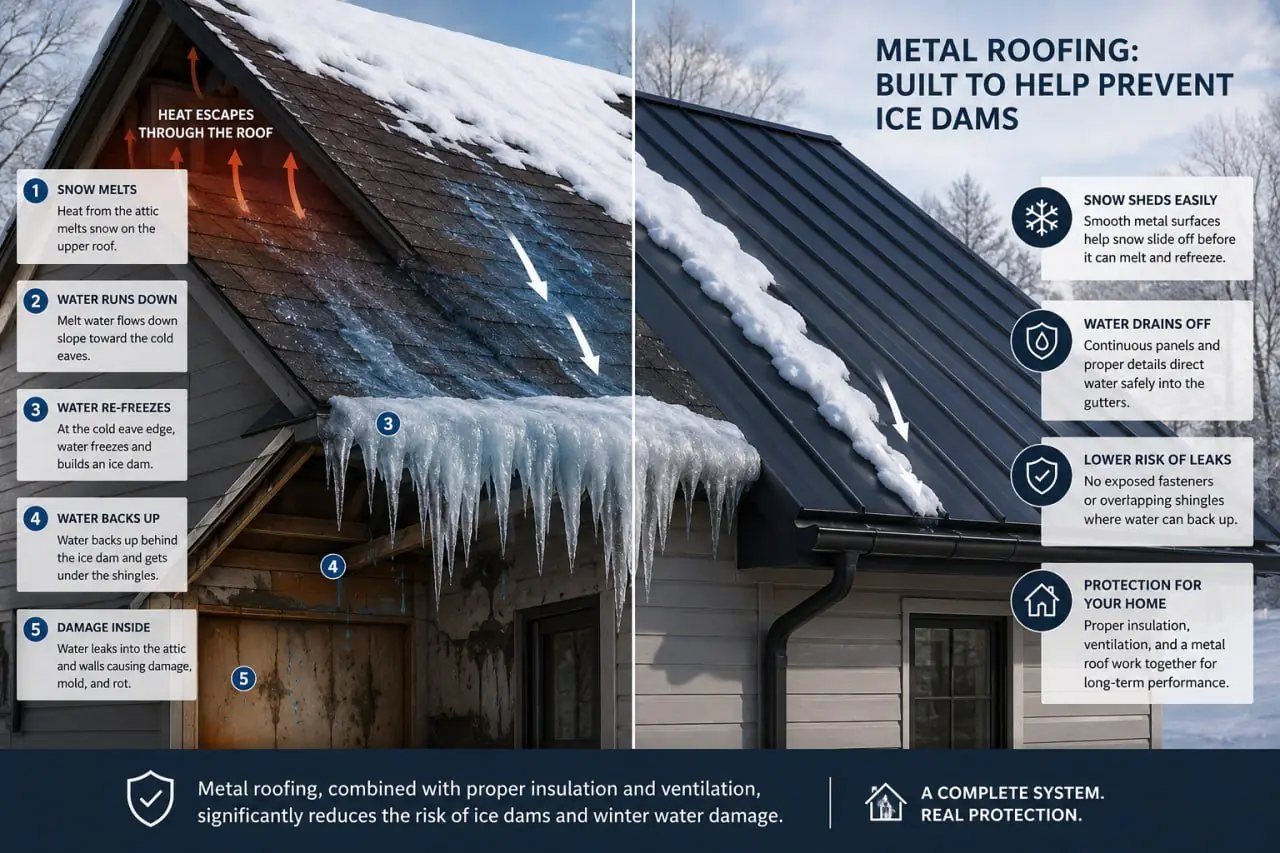
If you have lived through enough Ontario winters, you have probably seen them. A thick ridge of ice building up along the edge of a roof, sometimes hanging in dramatic icicles, sometimes growing quietly until it forces its way under the shingles and into the house. Ice dams are one of the most common and most destructive winter roofing problems in this region — and they are also one of the most misunderstood. Most homeowners who deal with ice dams treat them as a surface problem. They hire someone to chip the ice away, they add heated cables along the eave, or they simply wait for spring and hope the damage inside is not too bad. What they rarely do is address the underlying condition that created the ice dam in the first place. And without addressing that, the same problem returns the following winter.
What Actually Causes an Ice Dam
An ice dam forms when heat escapes from the interior of a home through the roof deck and warms the snow sitting on the upper sections of the roof. That snow melts and runs down toward the eave — but the eave is cold, because it extends beyond the heated building envelope. When the melt water reaches the cold eave, it refreezes. Over days and weeks, this cycle builds a ridge of ice at the eave edge. Water continues to run down from the warmer sections of the roof and pools behind that ice ridge. With nowhere else to go, it backs up under the shingles — or under whatever roofing material is present — and finds its way into the structure. Once water is inside the wall cavity or the attic, the damage is often significant: insulation saturation, drywall staining, mould, and in serious cases, structural damage to framing and decking. The root cause of virtually every ice dam is the same: inadequate attic insulation and ventilation, combined with a roofing material that has no mechanism for preventing the backup of water once it forms. Asphalt shingles are particularly vulnerable because their overlapping, layered design allows water to wick upward under capillary action when it pools behind an ice ridge.Why Metal Roofing Changes the Equation
Metal roofing addresses ice dam risk in two distinct ways — and understanding both is important. The first is snow shedding. A standing seam metal roof, in particular, has a smooth, continuous surface with no granules, no texture, and no gaps for snow to grip. As snow accumulates, it tends to slide off the roof rather than build up into the thick pack that generates significant melt water. This does not eliminate the heat-loss conditions that cause ice dams, but it reduces the amount of snow available to melt and refreeze at the eave. The second, more fundamental advantage is surface integrity. Unlike asphalt shingles, which rely on overlapping layers, a properly installed metal roof system — particularly a standing seam system with concealed fasteners — creates a continuous, sealed surface. This helps water drain off the roof more effectively and reduces the chance of water getting underneath the roofing system during harsh winter conditions. This does not mean a metal roof makes attic insulation and ventilation irrelevant. It absolutely does not. Poor ventilation will still cause premature wear, moisture buildup in the attic, and structural damage over time, regardless of what is on the roof above. But a well-installed metal roof significantly reduces the risk that ice dam water will enter the building even when conditions are severe.The Role of the Eave Detail in Ice Dam Prevention
One of the most critical — and most often overlooked — aspects of metal roof installation in Ontario is the eave edge detail. This is the point where the roof panel terminates at the lowest edge of the roof, where the fascia and eavestrough attach. In a properly executed installation, the eave detail is engineered to direct any water that reaches the edge cleanly off the roof and into the gutter system. The panel termination is sealed and formed in a way that prevents wind-driven rain or backed-up water from finding a path underneath. This level of detail is not visible from the ground once the job is done — which is exactly why it is so important to work with an installer who understands and prioritizes these hidden details.Solving the Actual Problem, Not Just the Symptom
A metal roof is a meaningful step toward eliminating ice dam damage. But it is not a substitute for addressing the underlying cause. If your home has significant heat loss through the roof deck — due to insufficient insulation, air leakage around pot lights or bathroom fans, or a poorly designed attic ventilation system — those conditions will continue to cause problems regardless of what the roof surface is made of. The most effective approach combines a high-performance roofing system with a properly designed and sealed attic envelope. When both elements are addressed together, ice dam formation becomes largely a non-issue — even in the harshest Ontario winters. That is the honest answer. Not a product pitch, but a complete picture of the problem and what it actually takes to solve it. 📄 If you’ve had ice dam problems and want to understand whether your roof is part of the issue, request a consultation. We assess the full system — not just the surface.Other articles


Get a free estimate
Leave your contacts and a few words about your project — we will call you back and prepare a clear estimate.